
There are easier countries to fall in love with than Ethiopia.
Start with this itinerary
Open this route in Honge as your starting point, then shape the days, stays, and pace around how you travel.
That was probably the first honest thing we realized after landing in Addis Ababa.
Not because Ethiopia lacked beauty. Quite the opposite. The country overwhelms you almost immediately with altitude, noise, incense smoke, traffic, Orthodox chants drifting from hidden churches, coffee roasting over charcoal, mountains appearing suddenly behind crowded streets, and a pace of life that never fully settles into what outsiders expect Africa to feel like.
But Ethiopia does not introduce itself gently.
And honestly, that became part of the reason we loved it.
This trip began with coffee, although by the end we realized coffee had only been the doorway into something much larger.
For years we had casually ordered Ethiopian beans in cafés back home without thinking very much about the places printed on the bags: Yirgacheffe, Sidama, Guji.
The names sounded beautiful but abstract, like distant tasting notes rather than actual landscapes where people woke before sunrise to harvest cherries from steep green hillsides.
Then one winter evening, while sitting in a café arguing about future travel plans, one of us asked a question that unexpectedly stayed with both of us: what would it actually feel like to drink coffee where coffee itself began?
Not “good coffee.”
Not specialty coffee culture.
The origin.
That question eventually pulled us toward Ethiopia.
At first we imagined the trip mainly through coffee: highland farms, slow ceremonies, misty mornings, wood smoke, fresh roasting.
But the more we researched the country, the more impossible it became to separate coffee from everything surrounding it: religion, hospitality, landscape, history, ritual, conversation, and time itself.
In Ethiopia, coffee is not simply consumed.
It structures social life.
People do not rush through it. Nobody walks around holding oversized takeaway cups while answering emails. Coffee arrives with incense, conversation, repetition, pauses, and patience.
And gradually we realized this was not going to become a “coffee tour.”
It was becoming something closer to a pilgrimage.
Planning the Route — And Learning to Slow Down
Originally we considered trying to see everything: Danakil, Omo Valley, Simien Mountains, tribal regions, volcanoes, deserts.
The more we researched Ethiopia though, the more obvious it became that trying to “cover” the country in ten days would completely destroy the spirit of the trip.
Coffee itself eventually became the filter for every decision.
Instead of asking:
“What are the most famous places in Ethiopia?”
we started asking:
“Which parts of Ethiopia help us understand why coffee matters so deeply here?”
That changed the itinerary entirely.
We built the route around: Addis Ababa, Lalibela, Yirgacheffe, Sidama, and the Bale Mountains.
The trip gradually moved from urban coffee culture into ancient spiritual Ethiopia, then deep into coffee-growing highlands, before finally opening into the cold, wide landscapes of Bale.
Domestic flights became essential. Ethiopia is enormous, roads take longer than maps suggest, and trying to overland everything would have turned the journey into constant transit exhaustion. Ethiopian Airlines’ domestic network turned out to be surprisingly good, especially when booked alongside international flights.
At the same time, we quickly learned that Ethiopia punishes overplanning. Flights shift, road conditions change, rain interrupts movement, and a simple invitation for coffee can quietly rearrange an afternoon.
Addis Ababa — Where Coffee Shapes Daily Life
Addis does not feel like the polished beginning of a romantic travel story.
The city is loud, chaotic, high-altitude, unpredictable, and permanently under construction. Traffic seems to invent its own rules every few minutes. Sidewalks vanish unexpectedly. Buildings swing wildly between glass towers and unfinished concrete.
But underneath that roughness there is extraordinary energy.
The first thing that surprised us was altitude.
Even walking uphill with luggage left us slightly breathless during the first afternoon. Addis sits over 2,300 meters above sea level, and the combination of thin air, exhaustion, and heavy traffic made the city feel strangely intense during those first hours.
The second surprise was how seriously coffee is treated everywhere.
Not performatively.
Not for tourists.
Just naturally.
Tiny roadside cafés roasted beans over charcoal while office workers lingered over macchiatos in crowded standing-room coffee bars. Families gathered for ceremonies that stretched leisurely across entire afternoons. Even inside the airport lounge, coffee somehow felt less transactional than in most international airports.
One practical thing we learned quickly in Addis was not to rely too heavily on cards once outside larger hotels and upscale restaurants. Ethiopia still runs largely on cash, especially in smaller towns and coffee-growing regions.
We exchanged a modest amount of Ethiopian birr after landing at Addis airport for immediate expenses such as SIM cards, taxis, snacks, tips, and cafés, but better exchange rates generally came later through bank ATMs inside the city.
Outside Addis, ATMs became far less predictable. Before we left for the south, our driver casually asked whether we had withdrawn enough cash for several days. At first that sounded overly cautious. A few days later, after watching card machines repeatedly fail during a rainstorm in coffee country because of connectivity issues, it suddenly felt like very good advice.
We also carried a small reserve of newer US dollar notes as backup. US dollars were far more useful than Euros once conversations moved into tourism logistics, emergency payments, or cash exchanges outside major cities.
One afternoon we wandered through Mercato, one of Africa’s largest open-air markets, and immediately lost all sense of orientation. Coffee sacks sat beside counterfeit electronics, incense vendors, spices, tangled wires, shouting traders, muddy alleyways, and endless movement in every direction. By the time we emerged several hours later, both of us were exhausted, slightly overwhelmed, and completely fascinated.
Addis constantly feels like that: intense, messy, alive.
One evening we ended up at a live Ethio-jazz performance in a dimly lit cultural venue while rain tapped softly outside. Honey wine circulated slowly between tables while musicians blended jazz rhythms with traditional Ethiopian melodies in a way neither of us had heard before.
That night mattered because it stopped Ethiopia from feeling frozen in ancient history.
The country suddenly felt contemporary, creative, young, and intellectually alive.
And still, somehow, every evening eventually circled back toward coffee again.
On our final night in Addis before flying north, a woman at our guesthouse prepared a full coffee ceremony that lasted nearly ninety minutes. Green beans roasted directly over charcoal while incense burned nearby. Nobody rushed anything.
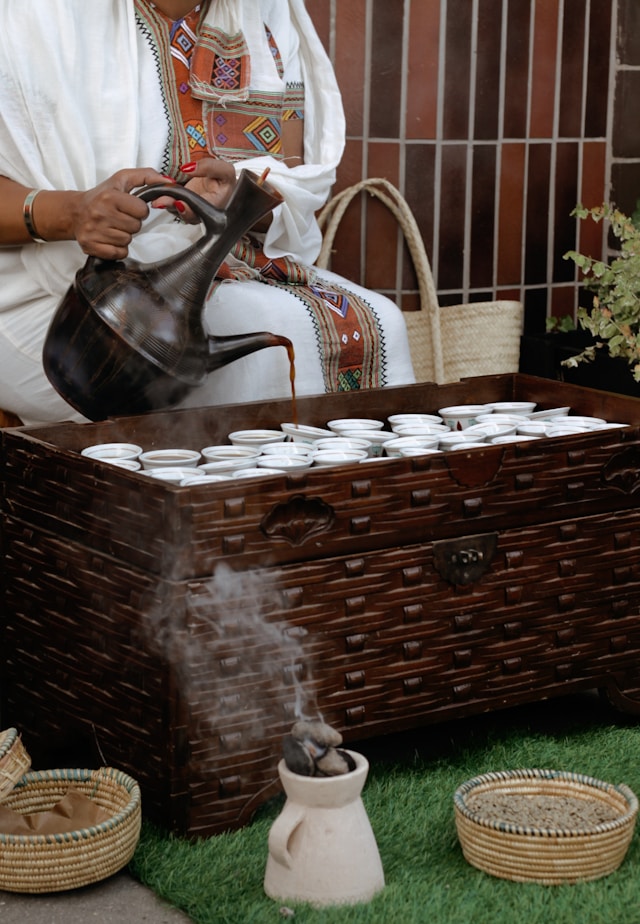
Back home, coffee usually exists to accelerate mornings.
Here it seemed designed to interrupt them.
Lalibela — Faith Carved Into Stone
The flight north into Lalibela crossed enormous highland landscapes broken by deep valleys and scattered villages that looked almost untouched by modern pace.
Nothing quite prepares you for Lalibela itself.
Photographs explain the architecture but not the atmosphere.
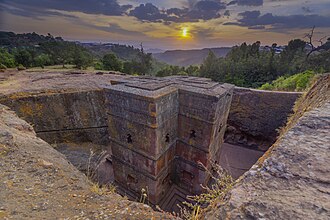
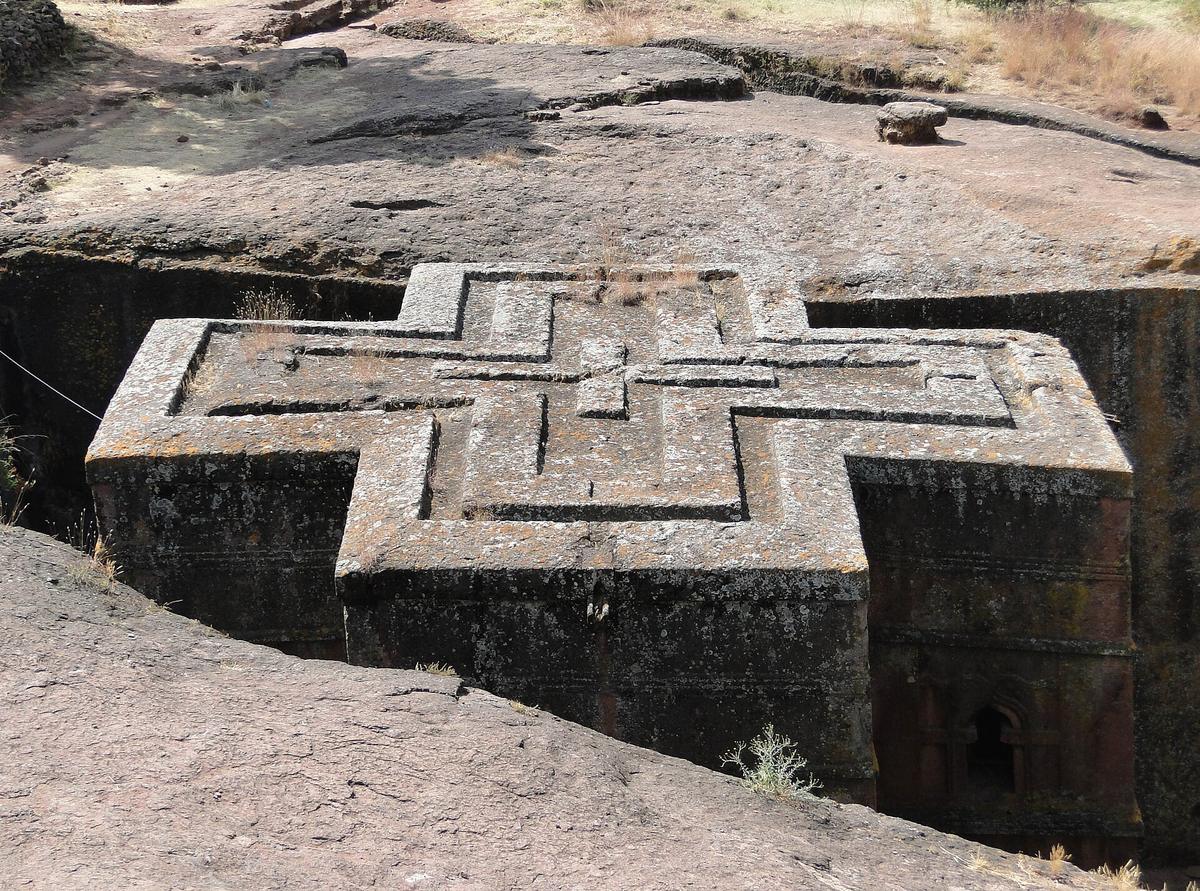
The churches are not ruins. They are living religious spaces carved downward into volcanic rock centuries ago and still filled with worshippers wrapped in white cotton garments moving silently through tunnels, courtyards, staircases, and candlelit chambers.
We arrived before dawn one morning for early prayers and spent nearly two hours simply following the sound of chanting through underground passageways illuminated by thin shafts of morning light.
At times the entire experience felt less like tourism and more like accidentally stepping into another century.
After the morning service, we sat outside with a local guide drinking small cups while priests and pilgrims slowly emerged into cold highland sunlight. Incense still lingered faintly in the air from the service.
The connection between prayer and coffee was not something anyone explained to us directly. It was simply there in the smoke, the waiting, the repeated gestures, and the way people made time for both.
We stayed one night in a modest family-run lodge on the edge of town rather than a larger hotel, and it became one of the most memorable decisions of the trip. Electricity disappeared briefly during the evening. Rain arrived suddenly after sunset. Somewhere nearby dogs barked continuously while coffee roasted in the kitchen late into the night.
Nothing about the stay felt luxurious.
But it felt deeply human.
The owner’s mother insisted on preparing another full coffee ceremony after dinner despite the late hour. By then we had already realized refusing coffee in Ethiopia feels almost emotionally impossible.
Hospitality arrives repeatedly here in liquid form.
Food in Lalibela also surprised us.
Before Ethiopia, we had unconsciously assumed African food would be heavily meat-focused everywhere. Ethiopia turned out to be far more layered because of Orthodox fasting traditions. On fasting days, many Ethiopians avoid animal products entirely, which means vegetarian food is not an afterthought. It is part of the cuisine's normal grammar.
Huge platters arrived covered with: lentils, spiced chickpeas, greens, potatoes, cabbage, and slow-cooked stews spread across injera.

At other meals, sizzling tibs — usually beef or lamb cooked with onions and berbere spices — arrived on hot metal platters surrounded by conversation and shared hands reaching constantly across the table.
Meals rarely felt individual in Ethiopia.
They felt communal.
South Toward Coffee Country
Until this trip, we had unconsciously imagined coffee origin regions as highly curated tourism landscapes.
Neat plantations.
Designer cafés.
Branded tasting rooms.
Southern Ethiopia turned out to feel far more agricultural and alive than that.
The roads gradually narrowed after leaving larger cities behind. Eucalyptus smoke drifted across villages in early mornings. Donkeys carried sacks beside muddy roads while children walked between coffee trees balancing bundles larger than themselves.
And then suddenly those familiar names started appearing on signs: Sidama. Yirgacheffe.

For years we had seen “Yirgacheffe” printed casually on café menus thousands of miles away without ever imagining the actual place itself: red earth roads, mist hanging over hillsides, coffee drying beds beside homes, women sorting cherries by hand, rain arriving suddenly over green mountains.
The emotional distance between global coffee culture and actual coffee-growing life collapsed surprisingly fast once we arrived there.
Yirgacheffe — Where Coffee Stops Feeling Abstract
This became the center of the journey, not because it was dramatic, but because it felt intimate.
We stayed near a small coffee-growing community connected loosely through a local lodge owner who knew several farming families nearby. It was not marketed as an “immersive cultural package.” In fact, very little felt packaged at all.
That was precisely why it worked.
The first morning began before sunrise with roosters, distant voices, and smoke drifting slowly through cold mist outside the room. Coffee trees covered the surrounding hillsides beneath eucalyptus shade while workers moved quietly through fields already beginning harvest activity.
The pace of life there felt tied to weather and harvest cycles more than clocks. Mornings began when the hills brightened, work shifted when rain arrived, and conversations often lasted longer than any plan we had written down.
Coffee cherries dried on raised beds beside homes while conversations unfolded slowly through partial translation, gestures, laughter, and repeated invitations for more coffee.
One afternoon we sat with a farming family during heavy rain while beans roasted over charcoal inside a dark kitchen filled with smoke and warmth. Outside, the hills disappeared completely into cloud.
Children wandered in and out carrying cups. Rain hammered the tin roof. Coffee kept arriving without ceremony being announced as ceremony.
The farther we traveled through Ethiopia, the more incomplete modern coffee language back home began to feel. So much of it revolves around flavor profiles, brew methods, water chemistry, and grind precision. All of that still matters, but it suddenly seemed like only one narrow way to talk about something much larger.
In that kitchen, coffee was not an object being evaluated. It was the reason everyone stayed seated together.
One evening after another ceremony lasting nearly two hours, we walked back outside beneath an unbelievably clear highland sky while the smell of roasting beans still lingered faintly on our clothes.
Neither of us said much for several minutes.
Yirgacheffe was no longer a tasting note. It was red earth on shoes, smoke in clothing, rain on tin, and people whose names we could finally attach to a word we had ordered casually for years.
Bale Mountains — Ethiopia Opens Up Again
After several dense days in coffee country, the Bale Mountains changed the scale of the trip.
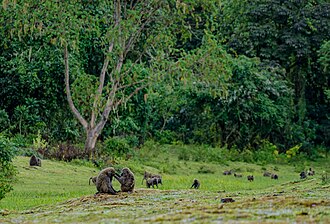
The landscape widened dramatically: huge plateaus, mist moving across valleys, horses grazing in open grasslands, and roads disappearing toward distant volcanic ridges.
This did not feel like safari Africa.
It felt closer to alpine wilderness.
The cold surprised us again at altitude. One morning began below freezing while fog drifted low across the Sanetti Plateau. Ethiopian wolves moved through the grasslands with strange fox-like elegance while giant lobelia plants emerged out of the mist looking almost prehistoric.
Roadside cafés appeared improbably in tiny settlements where sweet coffee arrived alongside bread, soup, and conversations with drivers waiting out sudden weather changes.
What Bale gave us was contrast. After the closeness of kitchens, farms, churches, markets, and ceremonies, the mountains offered distance: wind, cold air, open roads, and the feeling that Ethiopia could expand again just when we thought we had started to understand it.
Safety, Flexibility and Traveling Through Ethiopia Thoughtfully
Friends reacted to our Ethiopia plans with surprisingly polarized opinions.
Some talked about ancient churches and unforgettable hospitality. Others immediately brought up instability, headlines, or safety concerns.
The reality on the ground felt far more nuanced than either extreme.
Ethiopia never felt like the kind of destination where you completely switch your brain off and move carelessly through the country. We paid attention to regional conditions, avoided unnecessary night driving, relied heavily on local advice, and changed plans whenever weather, roads, or recommendations shifted.
That did not make the trip feel cold or guarded. Much of it was remarkably warm. But warmth and complexity existed together, and pretending otherwise would flatten the country into a simpler story than it deserves.
The practical lesson was straightforward: leave space in the route. Keep cash. Confirm local conditions. Do not build an itinerary so tight that one delayed flight, one closed road, or one long conversation ruins the day.
What Ethiopia Changed About Coffee For Us
By the time we returned to Addis Ababa for the flight home, coffee no longer felt remotely the same.
Not because we suddenly became experts.
Actually the opposite.
The trip mostly made us realize how incomplete our understanding had been before arriving.
In much of the world, coffee has become associated with: speed, productivity, caffeine, efficiency, and performance.
In Ethiopia, coffee still feels tied to: hospitality, ritual, slowness, conversation, and community.
That difference changes the emotional experience of drinking it.
We originally traveled to Ethiopia searching for the birthplace of coffee.
Instead, we found a country where coffee still behaves less like a commodity and more like a social language.
Somewhere between Addis Ababa, Lalibela, Yirgacheffe, and the Bale highlands, the trip quietly stopped feeling like tourism.
It started feeling like learning how to slow down again.
FAQ
Is Ethiopia good for coffee-focused travel?
Yes. Ethiopia offers a rare combination of origin-region visits, everyday coffee ceremony culture, and highland landscapes that connect coffee to daily life rather than only tasting experiences.
Which regions are best for understanding Ethiopian coffee origins?
Yirgacheffe and Sidama are excellent for origin context, while Addis Ababa helps you understand how coffee rituals continue in urban daily life.
Can you rely on cards throughout Ethiopia?
Not consistently. Cards are more reliable in larger hotels and upscale venues in Addis, but cash is essential in smaller towns and coffee-growing regions.
Is ten days enough for this Ethiopia route?
Ten days works if you focus on fewer regions and use domestic flights strategically. Trying to cover everything usually leads to transit-heavy fatigue.
Ready to make it yours?
Customize this itinerary with AI
Now that you've seen the full route, use Honge to tailor stays, activities, and day-by-day pacing to your trip.
Related itineraries
- 11-Day Mongolia Itinerary: Culture, Steppe & Photography
- 2-Week Georgia Itinerary: Tbilisi, Wine Country & Mountains
- 5-Day Portugal Solo Itinerary: Lisbon, Sintra & Porto
- 3-Day Maasai Mara Safari Itinerary for Friends & Couples
- 8-Day Uzbekistan Silk Road Itinerary: Samarkand, Bukhara & Khiva
- India Monsoon Itinerary: Kerala to Meghalaya
- 6-Day Bolivia 4x4 Itinerary: Uyuni Salt Flats & Altiplano
- 10-Day South Africa Itinerary: Cape Town, Winelands & Londolozi
- Vegetarian Japan Itinerary: 10 Days Through Tokyo, Kyoto & Osaka
About The Author
Honge is a travel planning platform focused on practical, experience-led itineraries. Our editorial travel stories combine first-person route context, local friction, and planning realism so readers can convert inspiration into workable plans. We prioritize grounded detail over checklist-style travel content.
Image credits: Photos are sourced from Wikimedia Commons and Unsplash. Copyright remains with the respective photographers and rights holders. Images from Wikimedia Commons are used in accordance with their applicable licensing terms, including the Creative Commons Attribution-Share Alike 4.0 International license where noted. Unsplash images are used in accordance with the Unsplash License.
Travel disclaimer
This itinerary is intended as general travel inspiration and planning guidance only — not as personalised travel advice. Conditions change. Before you travel, check the current entry requirements, visa rules, and any travel advisories issued by your government for your destination. Review weather forecasts for your specific travel dates, confirm opening hours and ticket availability for attractions directly, and take out comprehensive travel insurance that covers medical, cancellation, and disruption. Honge is not responsible for any changes to conditions, services, or experiences described in this article after the date of publication.