
Start with this itinerary
Open this Netherlands and Belgium solo route in Honge as your starting point, then shape museum slots, café evenings and train times around your pace.
Introduction
Trains run every 6 to 30 minutes between the six cities on this route. City centres are compact enough to cover on foot in a morning. Museums, cafés and canal-side bars are built for people sitting alone, not just couples and groups. That is what makes the Netherlands and Belgium one of the easier regions in Europe to travel solo, without a car and without an organised tour.
This itinerary runs Amsterdam, Utrecht, Antwerp, Ghent, Bruges and Brussels in a straight line south. No city gets revisited and no day gets lost to backtracking. Flights can open in Amsterdam and close in Brussels, or run round-trip from either city. Total travel time between any two stops on the route stays under 100 minutes, and most legs run 25 to 55 minutes.
Show up with a valid ticket and board any car — these are regional and Intercity trains, not reserved high-speed seats.
How Many Days in the Netherlands and Belgium Is Enough?
Eight days is enough for this straight-line solo train route: two nights in Amsterdam, then Utrecht, Antwerp, two in Ghent and one in Bruges, with Brussels as departure. Skip Rotterdam day trips and Luxembourg in this window; add Delft or The Hague if you have 10 days.
Keep the structure tight: one southbound line and short hops under 100 minutes. Trying to add Rotterdam, Delft, The Hague and Luxembourg into the same eight days usually turns museum mornings into station logistics.
The strongest version is this one: Amsterdam for arrival and museums, Utrecht as a calmer Dutch night, then Antwerp, two nights in Ghent and an overnight in Bruges before Brussels. Use the extension ideas below if you can stay longer.
Why This Trip Works
The distances are short enough that moving cities does not eat the day. Amsterdam to Utrecht is about half an hour; Ghent to Bruges is even shorter. That leaves time for a museum morning, a café lunch and an evening walk, rather than a station-to-station scramble.
Solo dining is straightforward in all six stops. Brown cafés in Amsterdam and Utrecht treat bar seating as normal. Antwerp's standing frituurs, Ghent's Patershol bistros and Bruges bars a few streets off the Markt are built for one or two people, not a reserved table of six.
The route also matches how people actually fly: Schiphol for arrival, Brussels-Zaventem or Brussels-Midi for departure, or a same-day train back to Amsterdam if the ticket is cheaper that way.
Good to Know
- Currency: Euro (€)
- Languages: Dutch in the Netherlands and Flanders; French is also common in Brussels. English is widely used in tourist services
- Trains: NS in the Netherlands; SNCB / Belgian Train in Belgium; NS International for the Utrecht–Antwerp change
- Cards: Contactless payment is standard
- Bicycles: Painted red lanes in Amsterdam and Utrecht have priority — look both ways before stepping off the pavement
Before You Go
- Book timed-entry tickets for the Rijksmuseum and the Van Gogh Museum if you are travelling April–September.
- If you want the Anne Frank House, tickets are sold online only. New batches typically release every Tuesday at 10:00 CEST for dates six weeks ahead; popular slots go quickly. Confirm the current release rule on the official site.
- Book the Utrecht–Antwerp train further ahead than the domestic legs. Advance fares on that cross-border change are often cheaper than walk-up prices.
- Pack one carry-on-sized bag. Ghent and Bruges cobbles are hard on a large wheeled suitcase.
Journey Overview
| Day | Base | Focus | Travel / getting around |
|---|---|---|---|
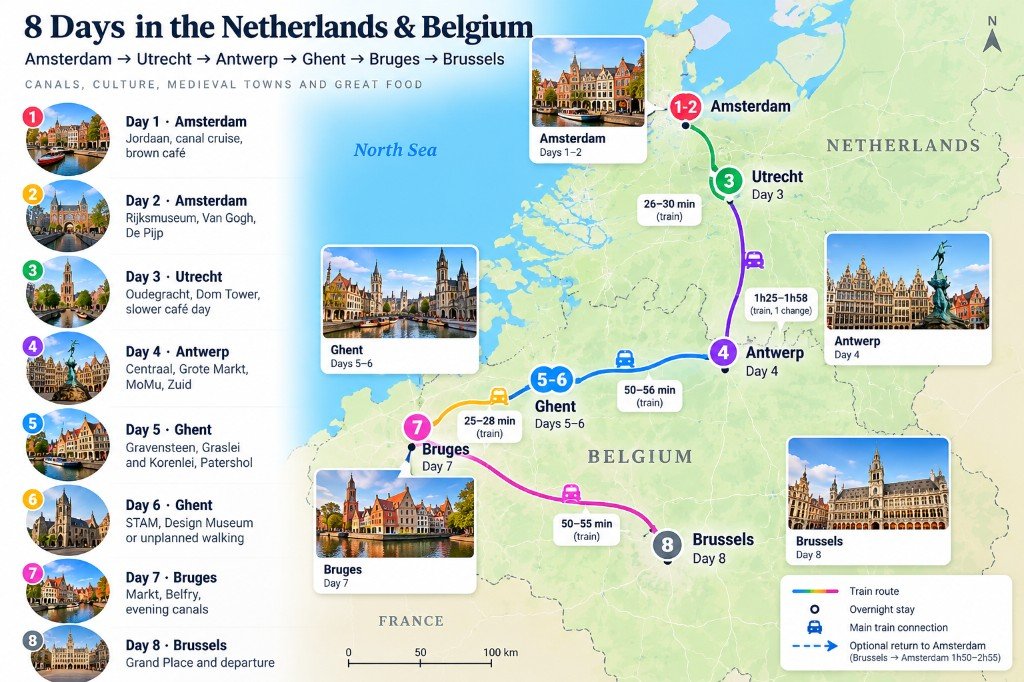
| Day 1 | Amsterdam | Jordaan, canal cruise, brown café | Schiphol → Amsterdam Centraal, 15–20 min, frequent |
| Day 2 | Amsterdam | Rijksmuseum, Van Gogh, De Pijp | Walking and tram |
| Day 3 | Utrecht | Oudegracht, Dom Tower, slower café day | Amsterdam → Utrecht, 26–30 min, every 6–10 min |
| Day 4 | Antwerp | Centraal, Grote Markt, MoMu, Zuid | Utrecht → Antwerp, 1h25–1h58, one change at Rotterdam |
| Day 5 | Ghent | Gravensteen, Graslei and Korenlei, Patershol | Antwerp → Ghent, 50–56 min, direct |
| Day 6 | Ghent | STAM, Design Museum or unplanned walking | Walking |
| Day 7 | Bruges | Markt, Belfry, evening canals | Ghent → Bruges, 25–28 min, direct |
| Day 8 | — | Grand Place and departure | Bruges → Brussels, 50–55 min; optional Brussels → Amsterdam 1h50–2h55 |
Route Map
Train times and fares
Every leg is a regional or Intercity service. Seat reservations are not required. Fares below are typical one-way walk-up or near-term prices and shift with the day of travel.
| Leg | Time | Frequency | One-way from |
|---|---|---|---|
| Amsterdam → Utrecht | 26–30 min, direct | Every 6–10 min | €9–12 (NS) |
| Utrecht → Antwerp | 1h25–1h58, 1 change via Rotterdam | Roughly hourly | About €26 (NS International) |
| Antwerp → Ghent | 50–56 min, direct | Every 20–30 min | €11–14 (SNCB) |
| Ghent → Bruges | 25–28 min, direct | Every 15–20 min | €9–11 (SNCB) |
| Bruges → Brussels | 50–55 min, direct or via Ghent | Every 30 min | €15–18 (SNCB) |
| Optional: Brussels → Amsterdam | 1h50–2h55 (Eurostar or Intercity) | Hourly | €29–59 |
Day 1 — Amsterdam: Jordaan and Canals
Amsterdam works as an arrival city because most of what a solo traveller needs sits within walking distance of the centre. Schiphol Airport connects to Amsterdam Centraal by direct train in 15–20 minutes, departing every few minutes through the day.
Start in the Jordaan, a grid of narrow canals, converted warehouses and independent shops west of the centre. A canal cruise in the late afternoon covers the Grachtengordel — the UNESCO-listed canal ring — from the water and needs no planning beyond showing up at a dock along Prinsengracht or Rokin. Evenings in Amsterdam centre on brown cafés: small, wood-panelled bars where solo seating at the bar is standard. De Sluyswacht, on the edge of the Jewish Quarter, is one of the oldest.
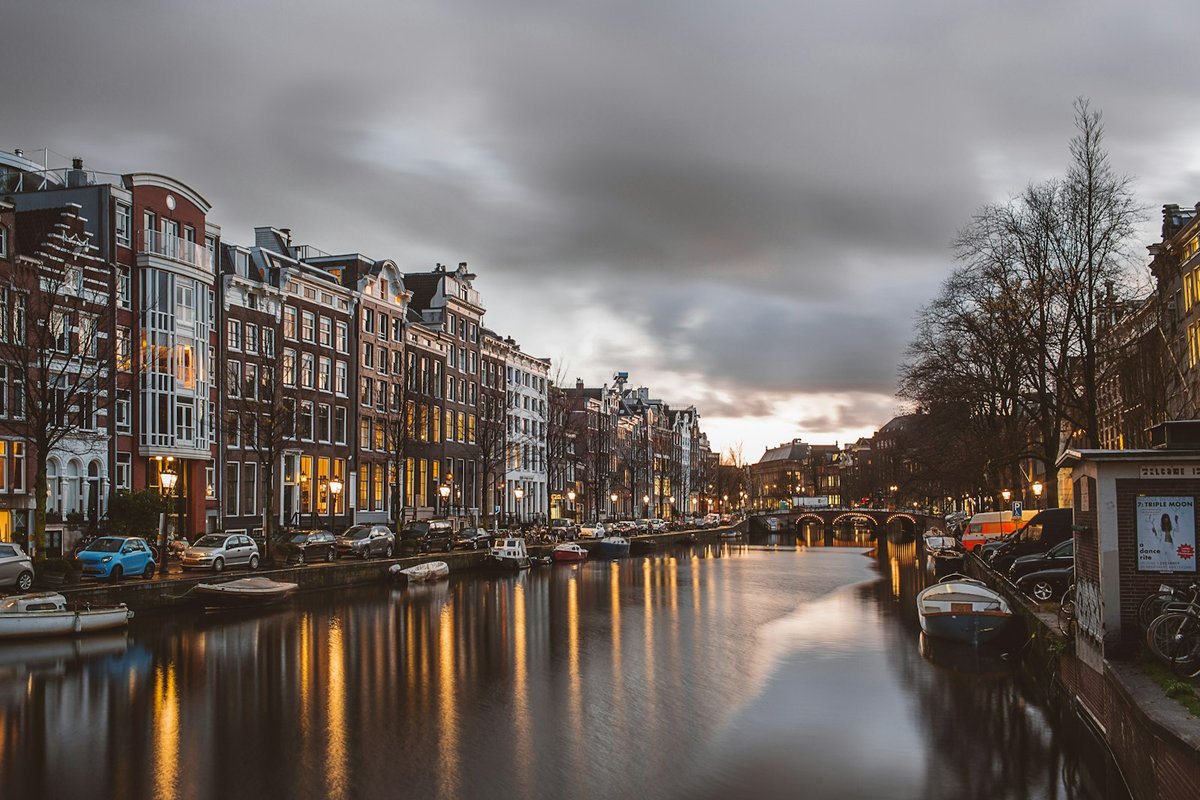
- Afternoon: Jordaan streets and a canal cruise from Prinsengracht or Rokin.
- Evening: A brown café; bar seating, a book and no expectation of company.
Tour on Honge
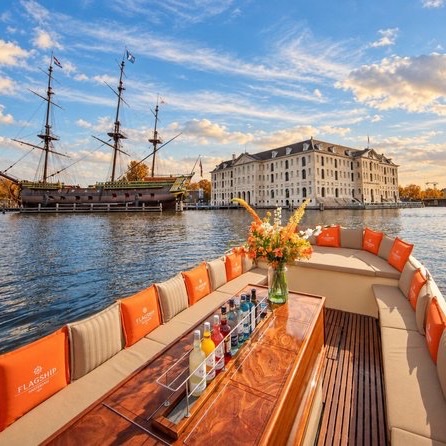
Amsterdam luxury canal cruise
See the UNESCO canal ring from the water on a one-hour electric boat cruise with a live guide. Departures run from central docks near Anne Frank House, the Rijksmuseum or Centraal, so it slots easily into a Jordaan afternoon without a full-day commitment.
Day 2 — Amsterdam: Museums and De Pijp
The Rijksmuseum and the Van Gogh Museum both use timed-entry tickets booked online in advance, especially from April through September. Museumplein connects both to the Stedelijk Museum if you want a third stop. I Amsterdam lists current hours and city cards.
In the afternoon, De Pijp offers a different Amsterdam — narrower streets, a younger population and the Albert Cuyp Market, an open-air strip of food stalls and produce vendors running six days a week. Small-plate restaurants and market stalls make solo dinners simple: order at a counter, eat standing or at a shared table. Foodhallen is another counter-service option if you would rather stay closer to the west.
- Morning: Rijksmuseum and Van Gogh (timed tickets).
- Afternoon: Albert Cuyp Market and a wander through De Pijp.
- Evening: Counter dinner in De Pijp, or a second brown café.
Day 3 — Utrecht
Utrecht is a 26–30 minute direct train from Amsterdam Centraal, with departures every 6 to 10 minutes — no booking required and little risk of missing a connection. Check NS for the day's timetable.
The city's defining feature is its two-level canal system: the Oudegracht runs below street level, lined with converted wharf cellars that now hold cafés, bars and small restaurants at the waterline. The Dom Tower, the tallest church tower in the Netherlands, anchors the old centre and can be climbed with a timed ticket bought at the base. Utrecht is smaller and quieter than Amsterdam, with a large student population that keeps café culture active without the tourist volume 30 minutes north.
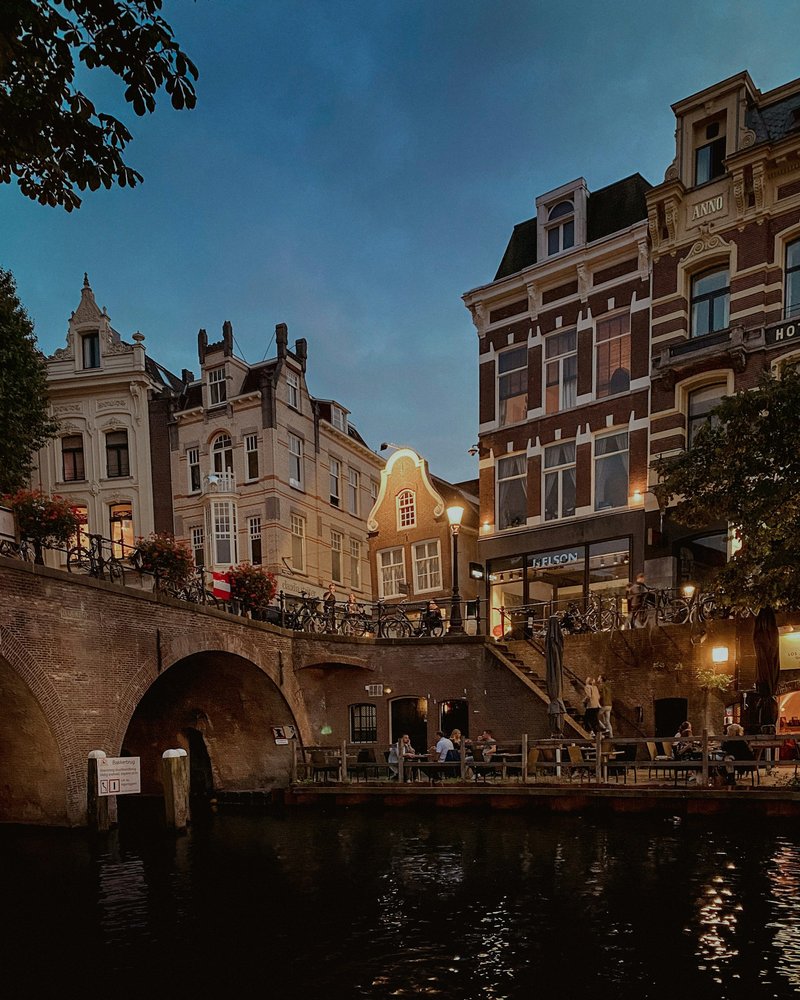
This is a one-day stop, best used to slow down after Amsterdam. A wharf-level café along the Oudegracht is the natural spot for a solo lunch — most have bar seating facing the canal. Visit Utrecht is a useful local overview.
- Morning: Train to Utrecht, then the Oudegracht and Dom Tower.
- Afternoon: Wharf-level lunch and a slower walk through the old centre.
- Evening: Stay near the Neude or along the Oudegracht, both a short walk from Utrecht Centraal.
Day 4 — Antwerp
There is no direct Utrecht–Antwerp train. The usual route is one change at Rotterdam onto a Eurocity Direct or Intercity service, taking about 1 hour 25 minutes to just under 2 hours. Book this leg on NS International further ahead than the domestic hops.
Antwerpen-Centraal is itself a destination — a domed, multi-level station finished in 1905.
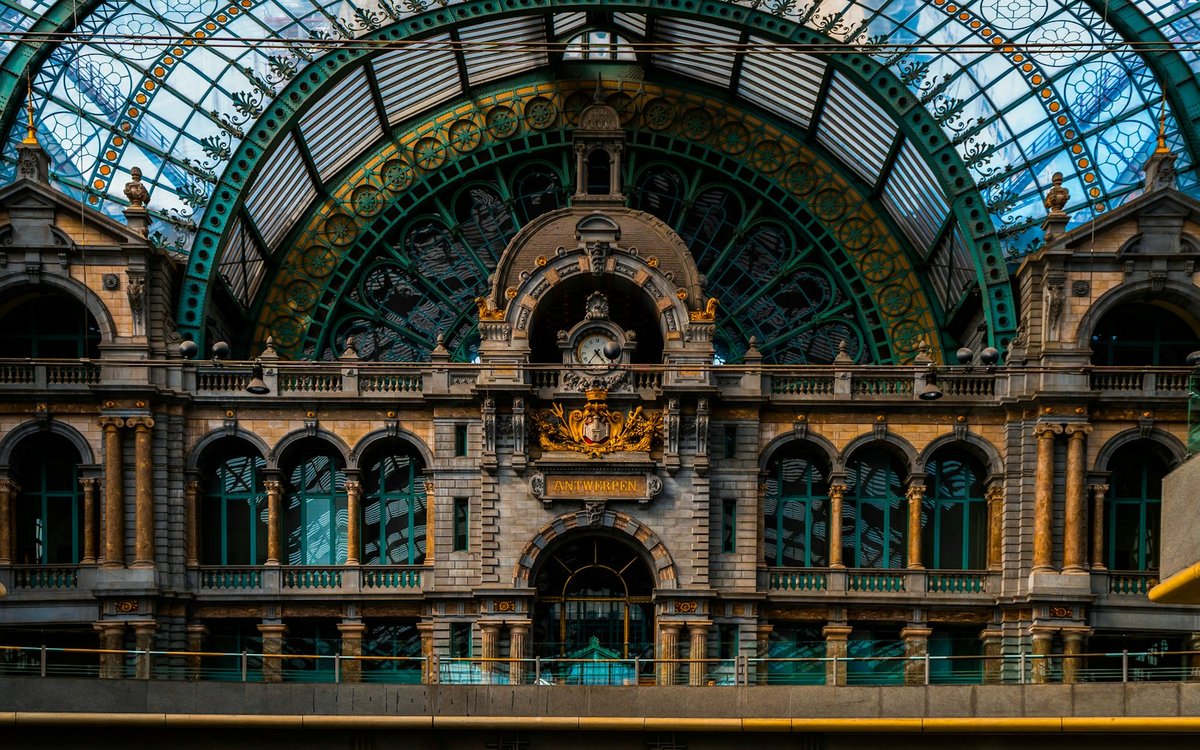
The old town centres on the Grote Markt and the Cathedral of Our Lady, a short walk from the station through the diamond district. Antwerp built its fashion reputation through the Antwerp Six; the MoMu fashion museum and the boutiques around Nationalestraat carry that history forward. The Zuid district, south of the centre, holds most of the city's contemporary galleries and design shops.
Evenings in Antwerp run later than in the Netherlands. Standing frituurs near the Grote Markt work well for a solo dinner that does not require a table, and the bars around Kloosterstraat stay active past midnight.
- Morning: Train via Rotterdam; pause in Antwerpen-Centraal before walking into town.
- Afternoon: Grote Markt, the cathedral and MoMu or Nationalestraat.
- Evening: Fries at a stand, then a bar on or near Kloosterstraat.
Day 5 — Ghent: Castle and Quays
Ghent is 50–56 minutes from Antwerp by direct SNCB train. It gets two days because it rewards slower exploration and because it carries a younger, less tourist-heavy atmosphere than Bruges, despite comparable medieval architecture. Visit Gent lists current events.
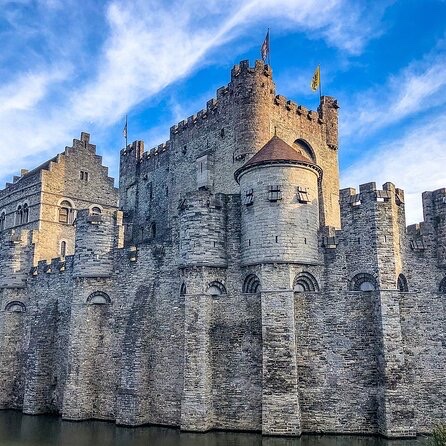
Gravensteen, the 12th-century castle in the city centre, sells timed tickets online to skip the entry line. The Graslei and Korenlei — two facing quaysides lined with guild houses — are the visual centre of the city, especially after dark when the buildings are lit. Patershol, the old tannery quarter, holds most of Ghent's small independent restaurants and is the best base for solo dinners at bar seating or shared tables.
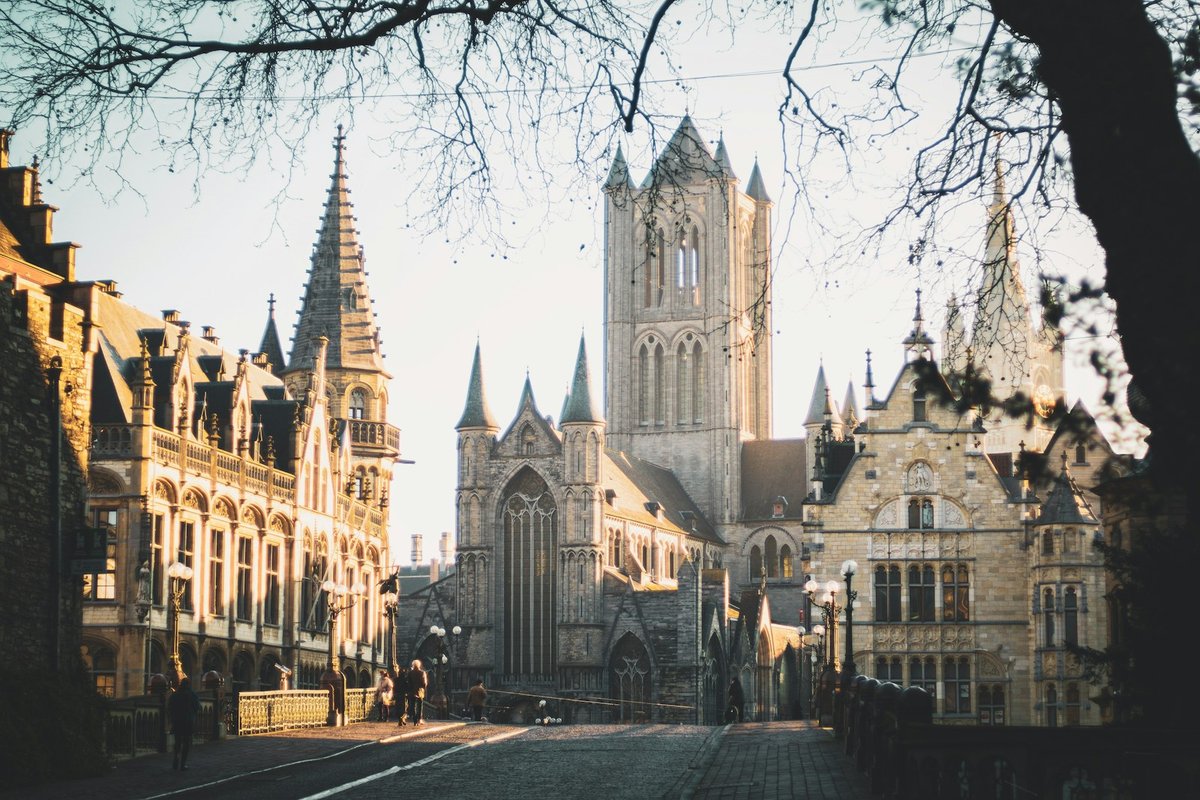
- Morning: Direct train from Antwerp; check in, then Gravensteen.
- Afternoon: Graslei, Korenlei and a first walk through Patershol.
- Evening: Dinner in Patershol; guild houses on the quays after dark.
Day 6 — Ghent: A Slower Day
The second day is built for the STAM city museum, the Design Museum Ghent, or simply walking the medieval streets without a fixed plan. Cuberdon candy stalls — small carts around the centre selling cone-shaped raspberry-flavoured sweets — are a local specialty worth trying once.
- Morning: STAM or the Design Museum, or a longer canal walk.
- Afternoon: Unplanned streets; cuberdons if you have not tried them.
- Evening: Another Patershol table, or an early night before the Bruges hop.
Day 7 — Bruges
Bruges is 25–28 minutes from Ghent by direct train, one of the shortest legs on the route. It is also the most visited city on this itinerary, and the day is built around that: arrive early, see the Markt, the Belfry and the canal loop before midday crowds build, then let the day-trip buses clear out by early evening. The historic centre is a UNESCO World Heritage site. Visit Bruges is the official city guide.
The Belfry limits entry by timed ticket because of its narrow internal staircase; book through Musea Brugge rather than risking a walk-up queue. Chocolate shops line nearly every street near the Markt — a small independent chocolatier a few streets back avoids both the tourist markup and the coach-tour crowds. Belgian beer, including Trappist and lambic styles, is worth tasting at a seated bar rather than standing at a shop counter.
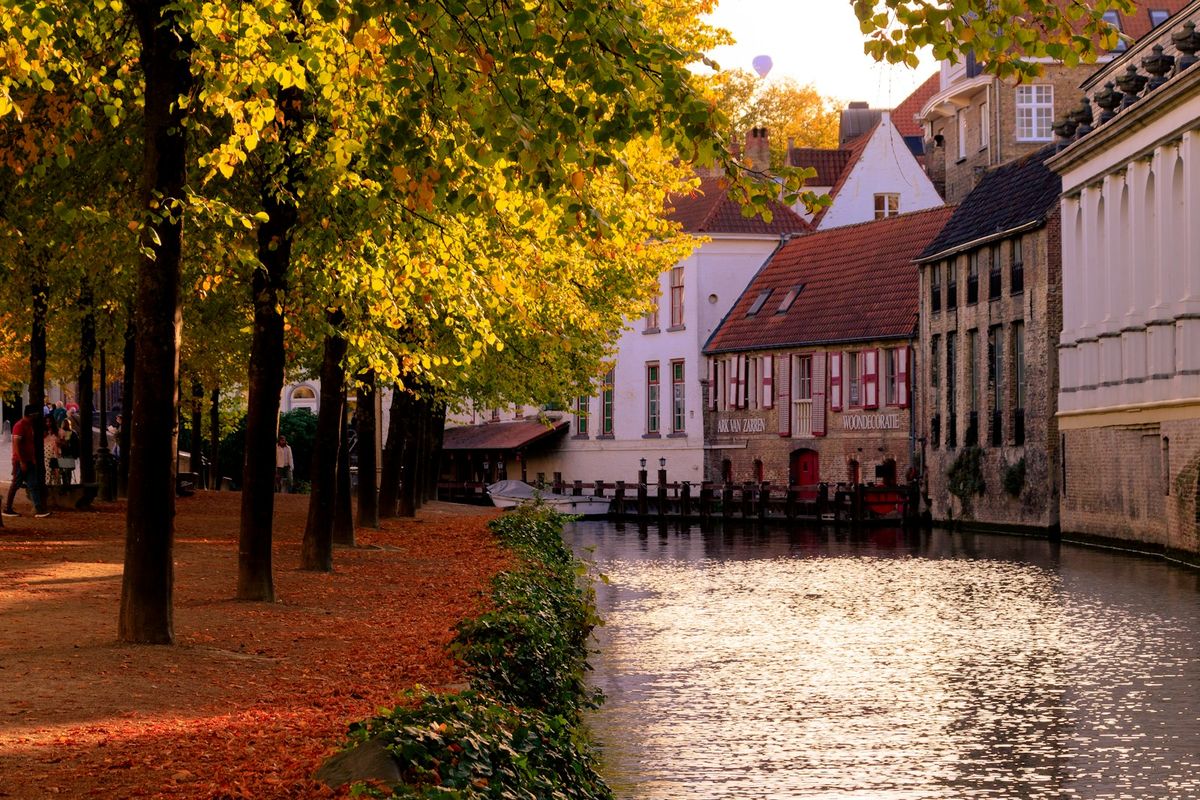
Bruges' best hours for a solo traveller are after 18:00, once the day-trip buses have left. The canals empty out, the lighting on the historic façades comes on, and the same streets that felt crowded at noon are quiet enough for an unhurried walk.
- Morning: Early train from Ghent; Markt and Belfry before the coaches arrive.
- Afternoon: Canal loop and a chocolatier off the square.
- Evening: A seated beer tasting, then a quiet walk once the buses have gone.
Tour on Honge
Bruges and Ghent day tour from Brussels
This itinerary gives Ghent and Bruges their own nights by train. If you prefer one guided day from Brussels instead — or you are ending with spare time there — this full-day coach tour covers both UNESCO medieval centres with a guide, including highlights like Gravensteen in Ghent and the Markt in Bruges.
Day 8 — Brussels and Departure
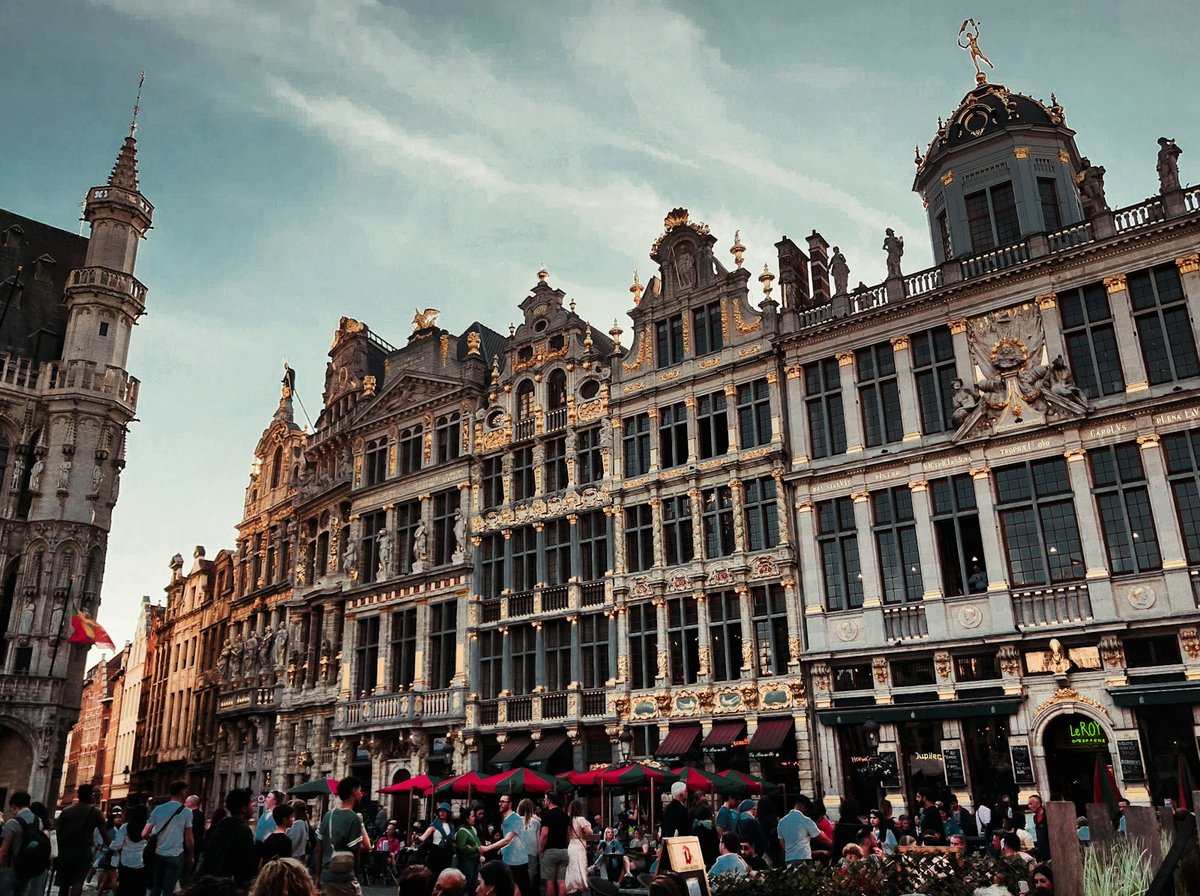
Bruges to Brussels runs 50–55 minutes by direct train, or with one change via Ghent. This final day is sized to fit around a flight: the Grand Place, one of Europe's most complete Baroque squares and a UNESCO site, is about a 10-minute walk from Brussels-Central or Brussels-Midi and needs no ticket.
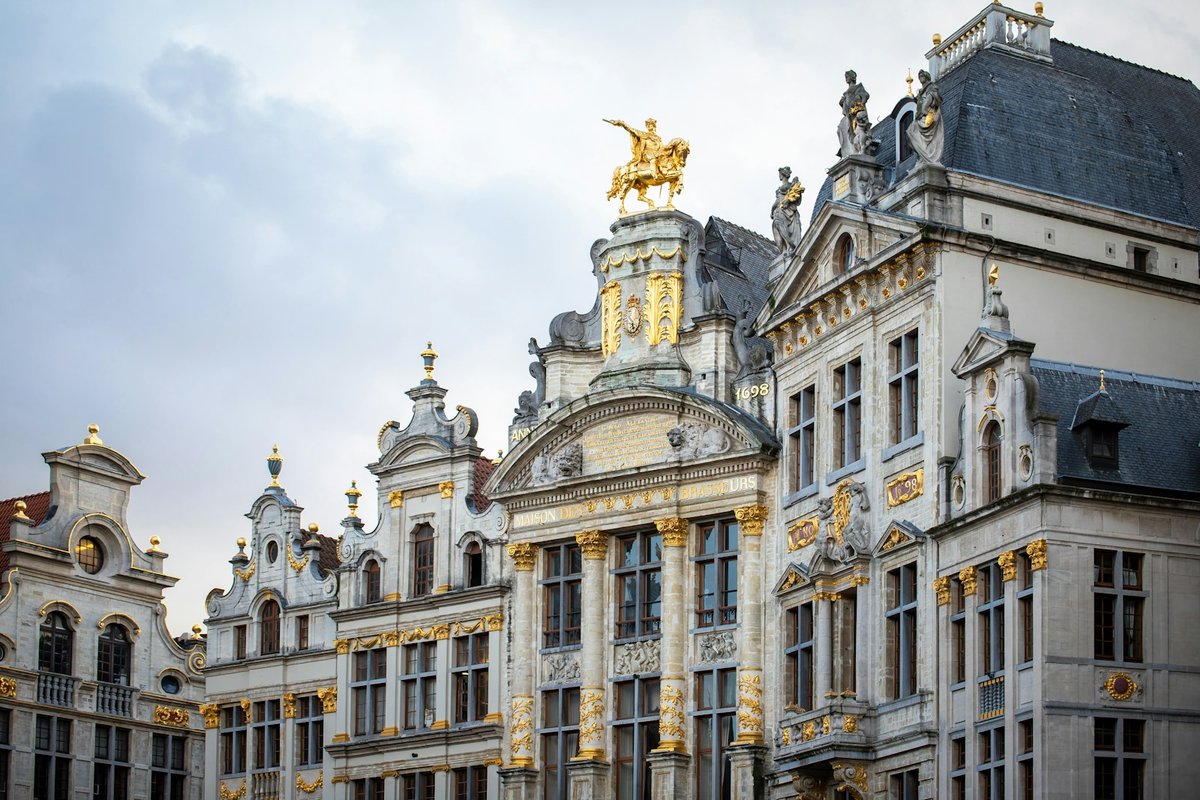
With a few spare hours, a fries stand near the Grand Place or the Magritte Museum both fit into a half-day without an overnight stay. Travellers flying out of Amsterdam instead of Brussels Airport can make this a same-day connection: Brussels to Amsterdam runs about 1 hour 50 minutes to 2 hours 55 minutes, with Eurostar and Intercity trains roughly hourly. visit.brussels covers the city if you do stay on.
- Morning: Train to Brussels; Grand Place on foot from Central or Midi.
- Afternoon: Fries or the Magritte Museum, then the airport or the train north.
Where to Stay
This route is planned around neighbourhoods rather than named hotels. Availability and rates rise sharply in Amsterdam and Bruges in July and August.
| City | Area | Why |
|---|---|---|
| Amsterdam | Jordaan | Canals, quieter nights, walkable to the centre and Centraal |
| Amsterdam (alt.) | De Pijp | More local, stronger food scene, 10–15 minute tram to the centre |
| Utrecht | Neude / Oudegracht | Wharf-level cafés, 5–10 minute walk from Centraal |
| Antwerp | Near the cathedral / Meir | Closest to the old town and Centraal |
| Antwerp (alt.) | Zuid | Quieter, design- and gallery-focused, still walkable |
| Ghent | Patershol | Restaurant-dense, quiet streets, short walk to Gravensteen |
| Ghent (alt.) | Korenmarkt | Shortest walk to the station and main sights |
| Bruges | Side streets off the Markt | Central without the noise of the main square |
| Brussels | Sablon or near Central | Short stay only — proximity to transit matters most |
Train Booking Tips
- Buy the Amsterdam–Utrecht, Antwerp–Ghent, Ghent–Bruges and Bruges–Brussels legs same-day or a day ahead. Domestic NS and SNCB fares do not swing the way French or German high-speed fares do.
- Book the Utrecht–Antwerp leg further ahead. It is the one cross-border, higher-cost, change-required segment, and advance fares are meaningfully cheaper than walk-up prices.
- Use the NS International or SNCB apps directly rather than third-party resellers, to avoid added booking fees.
- Weekend Eurocity Direct services and early-morning weekday trains fill up — book those a week or two ahead if dates are fixed.
- None of these legs require a seat reservation. A valid ticket boards any car on any departure it is valid for.
Best Time to Visit
Late April through June, and September, offer the best balance of mild weather and manageable crowds across all six cities. July and August bring the highest accommodation prices and the largest crowds in Amsterdam and Bruges. Winter is the cheapest and quietest season, apart from the December holiday-market weeks in Antwerp and Ghent, though daylight hours run short.
Solo Dining and Local Food
Amsterdam: bar seating at brown cafés (De Sluyswacht is a long-standing example), Foodhallen's market-style stalls, and De Pijp's small-plate spots around Albert Cuyp Market.
Utrecht: wharf-level cafés along the Oudegracht, most with counter or bar seating facing the canal.
Antwerp: standing frituurs near the Grote Markt; counter seating at cafés around Kloosterstraat.
Ghent: Patershol's small bistros, most with bar seating or shared tables built for one or two.
Bruges: anywhere a few streets back from the Markt — counter or bar seating, and menus without the tourist-square markup.
Brussels: standing counters near the Grand Place for fries and waffles, suited to a short solo stop rather than a sit-down meal.
The Netherlands
- Stroopwafels, ideally warm from a market stall rather than a sealed pack
- Haring (raw herring) from a street stall
- Bitterballen with mustard, standard bar food in any brown café
- Appeltaart, usually served with whipped cream
- Farmhouse cheese at Utrecht's markets, sampled before buying
Belgium
- Frites with a sauce beyond ketchup — andalouse or samurai are common local choices
- Stoofvlees, a Flemish beef stew braised in beer
- Waterzooi, a Ghent specialty — a creamy chicken or fish stew
- Mussels (moules), classically served with fries
- Liège-style waffles, denser and sweeter than the Brussels tourist-stand version
- A Trappist or lambic beer flight at a seated bar
- Cuberdons, Ghent's cone-shaped raspberry-flavoured candy
- Bruges chocolate from an independent chocolatier off the Markt
Good Evening Activities for Solo Travellers
- Canal walks in the Jordaan or along Utrecht's Oudegracht, both well lit and busy enough to feel comfortable alone
- Brown café culture in Amsterdam and Utrecht — bar seating, a book or a journal, and no expectation of company
- Graslei and Korenlei in Ghent after dark, when the guild houses are lit and the crowds thin out
- Bruges after 18:00, once the day-trip buses have left
- A seated beer tasting flight in any Belgian city — built for one person at a bar
- Late museum openings where available; several Amsterdam museums extend hours on specific weekdays
Safety and Practical Advice
- The Netherlands and Belgium both rank among the safer countries in Europe for solo travellers, day or night.
- Standard city precautions apply around Amsterdam Centraal, Dam Square and Bruges' Markt — these are the highest pickpocket-risk points on the route.
- Use official taxi apps rather than hailing on the street late at night in any of the six cities.
- Keep a photo or paper copy of ID and travel documents separate from the originals.
- Bicycle lanes are a genuine hazard for pedestrians unused to them, especially in Amsterdam and Utrecht. Check both directions before stepping into a painted red lane.
- Public transport (trains, trams, night buses) runs late in all six cities; you rarely need to plan around a last-departure cut-off.
Museum Reservation Tips
- Rijksmuseum and Van Gogh Museum: timed-entry tickets online in advance, especially April–September.
- Anne Frank House: 100% online, timed-entry only — no tickets at the door. New batches typically release every Tuesday at 10:00 CEST for dates six weeks out. Confirm the current rule before you travel.
- Gravensteen (Ghent): timed tickets on the Historic Houses site skip the entrance line.
- STAM and Design Museum Ghent: rarely need advance booking outside peak weekends.
- Belfry (Bruges): timed entry because of the narrow staircase; book online in peak season.
Luggage Between Cities
- Pack one carry-on-sized bag for the full eight days. Every stop involves some walking with luggage between the station and the stay, and cobbles in Ghent and Bruges are hard on large wheeled cases.
- Every train on this route is a regional or Intercity service with open luggage racks — no size limits or mandatory reservations like long-distance high-speed lines elsewhere in Europe.
- Station lockers are available at Amsterdam Centraal, Utrecht Centraal, Antwerpen-Centraal and Bruges station for same-day storage between hotel check-out and a later museum stop or train.
Itemised Budget for 8 Days (Per Person, Excluding International Flights)
These are approximate planning ranges in euros for one person, covering 7 nights. Mid-range assumes a private room, a mix of sit-down and counter meals, and one paid activity or museum entry most days. Amsterdam and Bruges sit at the high end.
| Item | Budget | Mid-range | Comfortable |
|---|---|---|---|
| Accommodation, 7 nights | €280–420 | €670–830 | €1,050–1,400 |
| Intercity trains, Amsterdam to Brussels | €70–100 | €78–108 | €100–160 |
| Food and drinks, 8 days | €180–250 | €270–350 | €400–560 |
| Local transport, museums and activities | €80–120 | €120–160 | €180–280 |
| Total per person | About €610–890 | About €1,150–1,450 | About €1,730–2,400 |
A return or same-day Brussels–Amsterdam train (€29–59) sits on top of the one-way figures. Hostels and market food pull the trip toward the budget column; 4-star hotels and a sit-down dinner every night push it toward the top of the comfortable range.
Extending Your Trip: 10, 12 or 14 Days in the Netherlands and Belgium
This 8-day route is the Amsterdam-to-Brussels solo train core. Extra days work best as a second Dutch or Belgian block, not squeezed between the same six overnight stops.
10 days: Delft, The Hague or a second night in Bruges
Keep this itinerary, then add two nights either in Delft or The Hague before you leave the Netherlands, or stay a second night in Bruges so the Markt evening is not your only quiet window. Do not treat Luxembourg as a casual day trip from this line.
12 days: Rotterdam or Haarlem plus deeper Flanders
Swap or add Rotterdam or Haarlem between Amsterdam and Antwerp, and keep two nights in Ghent. Use the extra buffer for rainy museum days and a slower Bruges morning. Keep the southbound order so you do not backtrack across the border twice.
14 days: Luxembourg or a return loop via Amsterdam
A fortnight can hold this 8-day core plus a dedicated Luxembourg City block, or a return to Amsterdam with day trips to the coast. Treat Luxembourg as its own base with a clear transfer day from Brussels, not a same-day dash from Bruges.
How to Arrive and Depart
Most visitors arrive through Schiphol and take the frequent train to Amsterdam Centraal. The itinerary ends in Brussels, so an open-jaw ticket — in via Schiphol, out via Brussels Airport or a Eurostar from Brussels-Midi — avoids a backtrack.
If you need to return to Amsterdam the same day, allow at least 1 hour 50 minutes on a fast service and more on a slower Intercity, plus a buffer before any flight.
What to Pack
- Comfortable walking shoes for cobbles in Ghent and Bruges
- A waterproof layer; canal cities stay damp even in summer
- A small day bag for museum days, so you can leave the main bag in a locker
- A contactless bank card
Key Places and Exact Locations
- Jordaan, Amsterdam: Day 1
- Museumplein: Day 2
- Albert Cuyp Market: Day 2
- Oudegracht, Utrecht: Day 3
- Antwerpen-Centraal: Day 4
- Grote Markt, Antwerp: Day 4
- Gravensteen, Ghent: Day 5
- Graslei, Ghent: Day 5
- Markt, Bruges: Day 7
- Grand Place, Brussels: Day 8
Useful Links
- NS — Dutch trains
- NS International
- SNCB / Belgian Train
- I Amsterdam
- Visit Utrecht
- Visit Antwerp
- Visit Gent
- Visit Bruges
- visit.brussels
- Visit Flanders
- Schiphol Airport
- Brussels Airport
- Rijksmuseum
- Van Gogh Museum
- Anne Frank House
- Gravensteen — tickets and hours
- Musea Brugge
- UNESCO — Grand Place, Brussels
FAQs
How many days in the Netherlands and Belgium is enough?
Eight days is enough for this straight-line solo train route: two nights in Amsterdam, then Utrecht, Antwerp, two in Ghent and one in Bruges, with Brussels as departure. Skip Rotterdam day trips and Luxembourg in this window; add Delft or The Hague if you have 10 days.
Do I need to rent a car?
No. Trains run every 6 to 30 minutes between the cities on this route, and the historic centres are compact enough to cover on foot. A car is more hindrance than help in Amsterdam, Ghent and Bruges.
When is the best time to visit?
Late April through June, and September, offer the best balance of mild weather and manageable crowds. July and August are the busiest and most expensive in Amsterdam and Bruges. Winter is cheaper and quieter, apart from December holiday-market weeks in Antwerp and Ghent.
Can I fly into Amsterdam and out of Brussels?
Yes. The itinerary is built as a one-way line south, so open-jaw flights work well. You can also fly round-trip from either city; Brussels to Amsterdam takes about 1 hour 50 minutes to 2 hours 55 minutes by Eurostar or Intercity.
Do I need seat reservations on these trains?
No. Every scheduled leg on this route is a regional or Intercity service. A valid ticket lets you board any car on a departure it is valid for. Book the Utrecht–Antwerp cross-border leg further ahead; the others can usually be bought same-day or a day in advance.
Is this route safe for solo travellers?
The Netherlands and Belgium both rank among the safer countries in Europe for solo travel, day or night. Standard city precautions still apply around Amsterdam Centraal, Dam Square and Bruges' Markt, which are the highest pickpocket-risk points on the route.
How much does this 8-day trip cost?
Plan roughly €610–890 per person on a hostel-and-market budget, €1,150–1,450 mid-range with private rooms, or €1,730–2,400 if you prefer 4-star hotels and sit-down dinners every night, excluding international flights.
Which museums need advance tickets?
Book timed-entry tickets for the Rijksmuseum and Van Gogh Museum, especially from April through September. Anne Frank House is timed-entry only, sold online. The Bruges Belfry and Ghent's Gravensteen are also easier with an advance slot.
Prompts to Try in Honge
- Plan a slower 10-day version of this Netherlands and Belgium route with two nights in Bruges.
- Swap Utrecht for Haarlem and keep the rest of the train line.
- Build a food-only two days in Amsterdam for a solo traveller.
- Add a day trip to The Hague from Amsterdam before going south.
- Compare flying out of Brussels versus returning to Schiphol.
- Find indoor backups for a rainy day in Ghent and Bruges.
- Plan this route with only carry-on luggage and station lockers.
- Add Rotterdam instead of Utrecht between Amsterdam and Antwerp.
- Create a beer-focused evening plan for Antwerp, Ghent and Bruges.
- Extend this trip with two nights in Luxembourg City.
Ready to Start Your Adventure?
Start with this Netherlands and Belgium solo itinerary on Honge, then tailor museum slots, café evenings and the Utrecht–Antwerp connection to your dates.
The route works because the trains are frequent and the centres are small. Leave a little room — for another canal walk, a longer brown-café stop, or an extra hour in Ghent before the hop to Bruges.
Ready for canals, guild houses and short train hops?
Plan your Netherlands and Belgium trip with Honge
Keep Amsterdam, Utrecht, Antwerp, Ghent and Bruges as bases, then shape museum tickets and evening walks around your pace.
Related itineraries
Written by
This blog was contributed by Ishita Minia, a travel enthusiast and writer. Ishita can be reached at ishitaminia@gmail.com.
About Honge
Honge is an AI travel planning platform focused on practical, experience-led itineraries with realistic pacing and logistics. All blog content is edited and published by Honge. Our Netherlands and Belgium research draws on updated practical logistics as of October 2026. © Honge. All rights reserved.
Image credits: Photos are sourced from Unsplash and Wikimedia Commons. Copyright remains with their respective photographers and rights holders. Unsplash images are used according to the Unsplash License. Wikimedia Commons images are used according to their applicable license terms: CC BY 2.0 or CC BY-SA 2.0.
Travel disclaimer
This itinerary is intended as general travel inspiration and planning guidance only, not as personalised travel, safety or medical advice. Train times and fares are estimates: NS, SNCB and Eurostar timetables shift by day and season, and the Utrecht–Antwerp change at Rotterdam can add minutes if a connection is tight. Museum slots, especially the Rijksmuseum, Van Gogh Museum, Anne Frank House and the Bruges Belfry, sell out in peak months — confirm release rules and opening hours on the official sites before you go. Bicycle lanes in Amsterdam and Utrecht have priority; step into a red lane only after checking both directions. If you return to Amsterdam on Day 8, do not book a tight flight after the Brussels train. Take out comprehensive travel insurance that covers medical treatment and cancellation. Suggested stay areas in this article are samples only and depend on availability; in the Honge app they may appear as booking options when offered by our vendors at the time of your search. Honge is not responsible for any changes to conditions, services or experiences described in this article after the date of publication.